


Last Updated: November 19, 2026
Quick Summary
Cold process soap benefits your skin by keeping the natural glycerin created during saponification, which attracts water and helps skin retain moisture. Plant oils like olive oil, coconut oil, and shea butter give a creamy lather and a cleansing profile that does not leave skin feeling tight.
- Cold process soap mixes plant oils with sodium hydroxide and lets saponification finish without added heat.
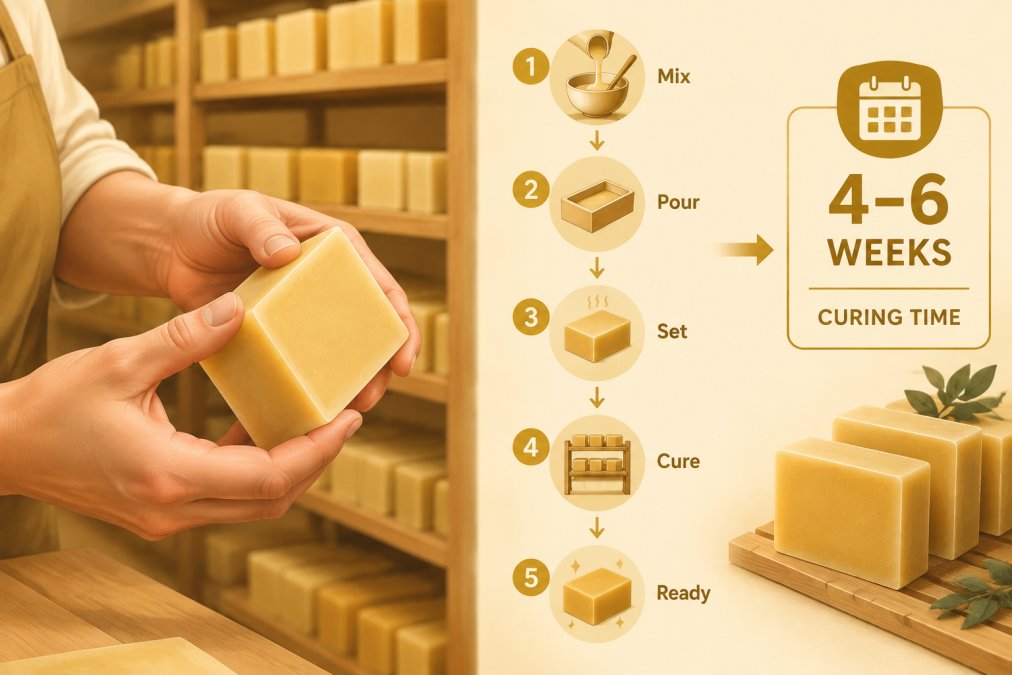
- The mixture thickens over roughly 30 to 45 minutes of stirring before it is poured into molds.
- Cold process soap needs a four to six week cure, while melt and pour needs none.
- A finished bar typically sits around pH 9 to 10, while healthy skin sits closer to pH 4.5 to 5.5.
- Patch test any new bar on your inner forearm for three to five days before facial use.
Table of Contents
- What Cold Process Soap Is and How Saponification Works
- Cold Process Soap Benefits for Skin: Glycerin, Oils, and Gentle Cleansing
- What Is Cold Process Soap vs Hot Process Soap?
- Cold Process Soap vs Melt and Pour: What Changes in the Bar
- Cold Process Soap Curing Time and Why Four to Six Weeks Matters
- Sensitive Skin, Fragrance, and How to Read a Soap Label
- Cold Process Soap Pros and Cons Before You Switch
- Shop by Skin Need: Picking Your First Cold Process Bar
- Frequently Asked Questions
What Cold Process Soap Is and How Saponification Works
Cold process soap is a bar made by mixing plant oils with sodium hydroxide, called lye, and letting the chemical reaction called saponification turn that mixture into soap without added heat. Amish Country Soap Co has been handcrafting soap in the family tradition for 250 years.
Cold process soapmaking preserves the natural glycerin created during saponification.
The Saponification Reaction in Plain Terms
Saponification is the reaction between a fat or oil and a strong base that produces soap and glycerin. In cold process soapmaking, lye dissolves in distilled water, then blends with plant oils like olive oil, coconut oil, and shea butter.
Those oils are made of fatty acids, and different fatty acids build different bars. Coconut oil contributes lather and cleansing strength. Olive oil contributes a milder, creamier skin feel. Shea butter adds richness that helps with moisture retention. A soapmaker balances them the way a cook balances seasoning.
If you want to see how a finished handmade bar performs before you commit, our review of buying cold process soap online walks through what to expect.
Cold Process Soap Benefits for Skin: Glycerin, Oils, and Gentle Cleansing
Most of the cold process soap benefits for skin trace back to three things: retained glycerin, plant oils, and a cleansing profile that does not leave your face feeling tight. That tightness after washing is a sign the bar pulled moisture from your skin barrier along with the dirt.
Natural glycerin and moisture retention
Glycerin, also labeled glycerol, is a humectant, meaning it attracts water from the air and holds it near your skin. Cold process soap keeps the glycerin that saponification makes. Many commercial bars remove it during processing because glycerin has resale value in lotions and other products.
One customer told us our soap "hydrated my 73 year old skin and it lasted."
What Is Cold Process Soap vs Hot Process Soap?
The difference between cold process and hot process soap is heat. Hot process soap is cooked after the oils and lye are combined, often in a slow cooker, which speeds saponification and lets the soapmaker add fragrance at the end. Cold process soap is poured at lower temperatures and left to finish on its own.
That distinction changes the bar in two ways.
- Skin feel: Hot process soap sets up chunky and gets pressed into molds, which produces a rustier, more handmade texture.
- Timing: Hot process soap is usable within days. Cold process soap needs a cure, which we cover below.
- Fragrance control: Hot process lets you add essential oils after the reaction, so less evaporates. Cold process requires choosing an essential oil blend that holds through curing.
If you are weighing handmade against mass-produced, our traditional vs factory-made soap comparison goes deeper into that trade-off.
Cold Process Soap vs Melt and Pour: What Changes in the Bar
Melt and pour soap is a pre-made base that a crafter melts and remolds. Cold process soap is made from raw oils and lye, start to finish. That is the whole difference, and it explains most of what follows.
| Feature | Cold Process | Melt and Pour |
|---|---|---|
| Made from scratch | Yes, oils plus lye | No, pre-made base |
| Glycerin content | Naturally retained | Varies by base |
| Cure time | Four to six weeks | None needed |
| Custom formulation control | Full | Limited to additives |
| Skin feel | Creamy, dense lather | Lighter lather |
Melt and pour is a fine entry point for a hobbyist. For a soap you plan to use on sensitive skin every day, cold process gives you ingredient transparency and full control over the formulation, because you decide every oil and every drop of fragrance.
Cold Process Soap Curing Time and Why Four to Six Weeks Matters
Cold process soap curing time is generally several weeks of air exposure before the bar is used.
What happens during those weeks:
Sensitive Skin, Fragrance, and How to Read a Soap Label
Fragrance is the most common reason a "natural" soap irritates sensitive skin, and the label is where you catch it. But reading a label well means understanding what soap chemistry does to skin, what fragrance actually contains, and what ingredient transparency can and cannot promise.
Why soap can sting sensitive skin: pH and the barrier
True soap, whether cold process or commercial, is alkaline. A finished bar typically sits around pH 9 to 10, while healthy skin surface sits closer to pH 4.5 to 5.5. That gap is normal and temporary, skin re-acidifies on its own after washing, but it explains why a strong cleanser can leave reactive skin feeling tight, dry, or prickly. Cold process soap, like all true lye-based soap, is alkaline. What cold process changes is what stays in the bar: retained glycerin and unreacted oils can soften the after-feel, but they do not turn an alkaline cleanser into a treatment.
Fragrance versus essential oils: both can sensitize
A label that says "fragrance" or "parfum" is a legal catch-all that can hide dozens of compounds, including known allergens. Essential oils are not automatically gentler. Many contain the same volatile compounds, limonene, linalool, eugenol, citral, that trigger contact dermatitis, and some, like cinnamon, clove, and citrus peel oils, are among the more irritating. A soap can be free of synthetic fragrance and still provoke a reaction. That is why "natural" is a sourcing claim, not a safety claim.
How to evaluate a soap label in practice
Read the ingredient list in order and use these criteria:
- Named essential oils beat "fragrance." A bar that lists "lavender essential oil" tells you more than one that lists "fragrance." It does not tell you the bar is non-irritating, only what the scent source is.
- Sodium hydroxide is expected. It is the lye, and in a properly formulated, fully saponified, cured bar none remains. Its presence is a sign of real soapmaking, not a hazard.
- Short lists are easier to audit. Distilled water, olive oil, coconut oil, shea butter, essential oil, sodium hydroxide, you can evaluate each line. Long lists with dyes, synthetic chelators, and multiple fragrance components are harder to assess.
- Watch for added colorants and botanicals. Dyes, mica, and dried petals add visual appeal but also potential irritants, especially in a bar used on the face.
- Transparency is not a guarantee. Full disclosure lets you judge a formulation; it does not certify mildness, hypoallergenicity, or clinical safety. Only patch testing on your own skin answers that.
Patch testing and realistic expectations
Patch test any new bar on your inner forearm for three to five days before using it on your face or body. Stop at the first sign of redness, itching, or burning. For anyone with eczema, psoriasis, or rosacea, treat soap as a cleanser and not a therapy, it can support comfortable skin, but it will not resolve a diagnosed condition. Our guide to essential oils in soap explains which oils are generally considered gentler and which are more likely to provoke reactions.
Cold Process Soap Pros and Cons Before You Switch
Cold process soap is not the right bar for everyone, and we would rather tell you that than sell you the wrong thing. A fair comparison weighs skin feel against safety, cost, and environmental trade-offs, not just packaging.
Pros:
- Natural glycerin stays in the bar, so skin often feels moisturized rather than tight
- Full ingredient transparency, since every oil and essential oil is named
- Plant oils and butters like shea butter and olive oil can support comfortable, hydrated skin
- A properly cured bar is dense and long-lasting in the shower
- Small-batch production lets a maker control formulation and avoid unnecessary additives
Cons:
- Higher upfront cost per bar than drugstore soap
- Four to six weeks of curing limits small-batch supply
- Essential oil scents are subtler and can fade faster than synthetic fragrance
- No bar suits every skin type, so some trial is unavoidable
- Alkaline pH means true soap is not a treatment for diagnosed skin conditions
Safety and quality control: what separates a good bar from a risky one
Cold process soapmaking uses sodium hydroxide, a caustic material that must be handled with care, gloves, eye protection, and proper ventilation are standard. That is a maker's concern, not a buyer's, but it matters because a poorly formulated bar can be unsafe. A bar made with too much lye, or one sold before saponification is complete, can irritate skin. A properly made bar is fully saponified and cured; the lye is consumed in the reaction. When you buy, favor makers who disclose their formulation approach, cure times, and batch practices. "Handmade" alone is not a quality guarantee, it is a production method.
Environmental trade-offs beyond packaging
Plastic-free packaging is a real benefit, but it is not the whole sustainability picture. On the other side, plant oils have their own supply chains, palm oil in particular is linked to deforestation unless sourced responsibly, and essential oils can be resource-intensive to produce. A short, locally sourced ingredient list and responsible palm sourcing usually matter more than the wrapper. Treat zero packaging as one factor, not a complete assessment.
The honest limitation
Cold process soap is a cleanser, not a treatment for diagnosed skin conditions. If you have rosacea-prone skin, our roundup of natural soaps for rosacea-prone skin narrows the field.
Shop by Skin Need: Picking Your First Cold Process Bar
Start with your skin's biggest complaint, not with the scent you like best. That single switch saves most first-time buyers a wasted bar.
- Dry or mature skin: Look for shea butter high in the list. Our Beach Nut Vanilla & Acai Berry bar includes shea butter, along with olive oil, coconut oil, and palm oil, at $6.00.
- Shorter ingredient lists: The Patchouli bar lists olive, coconut, palm, avocado oil, and patchouli essential oil, $6.00.
- Goat's milk: The Jasmine White Lily & Cherry bar includes goat's milk alongside avocado and castor oils, $6.00.
- A bold scent: The Bay Rum Gladiator bar is made with a blend of essential oils, $9.00.
Buy one bar, use it for two weeks, and judge by how your skin feels after drying off, not during the shower. That is the only test that matters. You can browse the full bar soap collection by skin need when you are ready.
The hardest part of switching to handmade soap is trusting that a simpler bar can do more for your skin than a shelf full of drugstore products. We have built our soapmaking on 250 years of family tradition, using pronounceable ingredients and cold process methods.
Frequently Asked Questions
Why is cold process soap better than commercial soap?
Cold process soap retains the natural glycerin that forms during saponification. Cold process also lets the maker control the plant oils in each batch.
What are the downsides of cold process soap?
Some formulations include essential oils or botanicals that can irritate very reactive skin, so patch testing a new bar first is a sensible step.
How long does cold process soap last?
A cured cold process bar typically stays usable for about a year when stored dry, and longer if kept cool and away from humidity. Once you start using it, expect roughly three to four weeks of daily showers from a 4 oz bar, depending on how often it sits in water. Letting the bar drain between uses is the single biggest factor in bar longevity.
Does cold process soap need to cure before use?
Cold process soap is cured after it is poured, so that the saponification process can finish before the bar is used.
Price per bar of cold process soap options


